Programs Abroad for Any Age — Yana Immis
Free consultations for study abroad, summer camps, language courses and sports programs worldwide. Any age, any country. I answer personally.
What the audit found, where it appears, and what each finding means for visitors and search engines.
What search engines can reach, which addresses they receive, and what visitors see when a page is missing.
A September 3 crawl checked every URL listed in the public XML sitemap.
What “returned 200” means: every page currently listed in the site’s sitemap loaded normally when tested. None led to a missing or broken page, so search engines had a working path to every listed URL.
The site uses the secure https://www domain as its main host and redirects the unsecured version to it. http://yanaimmis.com/redirects tohttps://www.yanaimmis.com/Without this redirect, search engines could treat the host versions as separate copies and divide their ranking information. The current redirect keeps visitors and search engines on one clear, secure host; the separate page routes discussed below are a different issue.
The site has a working robots file with crawler instructions and an XML sitemap listing its public pages. Without the sitemap, new or deeply linked pages can be harder to discover; without the robots file, crawlers lose the site’s explicit instructions. Both are currently available and help search engines crawl the intended pages, although neither raises rankings by itself.
The site currently lists 21 category pages and 10 tag pages in its sitemap, making every archive available for search engines to discover and assess. Archives with only repeated links may add little value, while clearly described archives can help visitors and search engines understand each topic. Reviewing the less useful archives could reduce repetitive pages competing for attention without removing the article library. See every archive URL.
 Missing address displays the homepage
If someone opens an address for a page that no longer exists, this site sends the correct HTTP 404 missing-page signal to search engines but displays the homepage to visitors without changing the address. Search engines can recognize that the page is missing; visitors may think they reached the wrong place because they are not told what happened. You can decide whether the current homepage fallback or a dedicated missing-page message is more useful for visitors.
Resources: September 3 crawl results plus HTTP observations, sitemap inventory, and URL metadata inventory. See all supporting files.
Related improvement plan: crawl foundations, duplicate routes, and archive-page decisions.
Visual examples of what browsers, Google, Facebook, LinkedIn, and X receive from the site.
The homepage and 18 other core pages currently have titles, descriptions, preferred-URL tags, Open Graph fields, and X fields. This gives search engines and social platforms the basic information needed to describe and share those pages. The wider 198-page crawl found gaps and repeated information on other URLs that can make some results harder to distinguish.
 Programs Abroad for Any Age — Yana Immis
The site has a 32×32 WebP favicon that can appear in browser tabs, bookmarks, and Google results. WebP is the file format and is supported; 32×32 is the image resolution. A larger square source could look sharper when browsers enlarge it, but the current icon already provides recognition and favicon size does not improve rankings.
Enlarged view of the current Yana Immis faviconFree consultations for study abroad, summer camps, language courses and sports programs worldwide. Any age, any country. I answer personally.
These pages are on the site and load normally, but their description field is empty. Google can still show them, but it must choose other page text for the result summary. Clear descriptions could give searchers a more predictable explanation of each page.
/blog/happy-birthday-2024/blog/year-in-review-and-happy-holidays-from-yana-immis-2022-2023/blog/category/Success+Story/blog/category/Scholarships/blog/category/Customer+Reviews/blog/category/Language+School/blog/category/Pathway/blog/category/Living+Expenses/blog/category/Business+School/blog/category/Bachelor/blog/category/MBA/blog/category/University+News+%26+Visits/blog/category/Master/blog/category/From+The+Author/blog/category/University+Profile/blog/category/YouTube+Video/blog/category/Useful+Tips/blog/category/Studienkolleg+Profile/blog/category/News/blog/category/German+Language/blog/category/Foundation/blog/category/Language+School+Profile/blog/category/Accommodation/blog/tag/2019/blog/tag/2026/blog/tag/2025/blog/tag/News/blog/tag/2024/blog/tag/2023/blog/tag/2022/blog/tag/Ask+Sofia/blog/tag/2021/blog/tag/2020These titles are currently repeated across different pages. Search engines can still index them, but people may not know which result matches their need. Distinct titles could make each page’s purpose clearer.
/blog/gmat-best-practices-to-score-at-least-600-part-2/blog/gmat-best-practices-to-score-at-least-600-part-1/blog/german-student-visa-granted-how-to-move-to-germany-in-23-fast-and-easy-steps-part-2/blog/german-student-visa-granted-how-to-move-to-germany-in-23-fast-and-easy-steps-part-1/blog/14-takeaways-from-my-study-abroad-experience-in-germany/blog/10-years-later-my-study-abroad-experience-in-germany/blog/category/News/blog/tag/News About Me
 Learn About Me
People cannot distinguish these pages by title in Google results, and Google may choose one page to show instead of the other.
/blog/yury-bachelor-student-from-ukraine/blog/anastasiya-nederytsia-master-student-from-ukraine/blog/study-in-germany-without-blocked-account/blog/study-in-germany-without-blocked-account-Each main page below currently has both a title and a description. Without them, Google would have to infer more of the search-result wording from the page. Their presence provides a usable foundation, while the repeated titles listed above still limit how clearly some pages differ.
/Title + description present/homeTitle + description present/about-meTitle + description present/learn-about-meTitle + description present/applicationTitle + description present/apply-to-any-university-and-country-hereTitle + description present/success-storiesTitle + description present/contactTitle + description present/faqTitle + description present/schools-and-universitiesTitle + description present/why-study-in-germanyTitle + description present/services-and-reviewsTitle + description present/my-philosophyTitle + description present/useful-tipsTitle + description present/partner-institutionsTitle + description present/target-countriesTitle + description present/study-abroadTitle + description present/learn-about-germanyTitle + description present/study-abroad-programsTitle + description presentThe homepage preview shows the title as the clickable result name and the description beneath it. Both fields are currently present, so Google has relevant wording to use, although Google may still rewrite either one for a particular search.
The site has Open Graph information for Facebook and LinkedIn and equivalent fields for X. Without these fields, each platform would have to guess which title, text, and image to show.

| Platform field | Live status | What was found |
|---|---|---|
og:title / og:description | Present | All 19 checked pages provide share text, so Facebook and LinkedIn do not have to invent it from the page. |
og:url / og:type | Present | Every checked page identifies its URL and labels itself as a website page, giving platforms a clear address to attach to the preview. |
og:image | HTTP image URLs | All 19 pages provide an image, but every address begins with insecure http://. Secure image addresses could make preview loading more reliable on secure platforms. |
og:image:alt | Not measured | The saved audit cannot confirm whether the share images describe themselves to screen readers, so their accessibility cannot yet be judged. |
twitter:card | Present | All 19 checked pages request X’s compact summary card. This is a valid preview format; it simply gives the image less space than the large-image card. |
| X title / description / image / URL | Present | All checked pages provide these fields, so X receives complete preview information instead of guessing from the page. |
| Platform preview test | Not measured | No Facebook, LinkedIn, or X preview test was supplied. The fields exist, but their final appearance and any platform caching remain unconfirmed. |
The checked pages have preferred-URL tags, which tell Google which address should represent the content. The route combinations below are also live, so Google receives competing signals and must decide which address to show.
/study-abroaddeclares the preferred URL as/Both routes are currently crawlable, while the preferred-URL tag points to the root. One consistent address would make the site’s choice clearer and keep links and ranking information together.
Both pages are currently public and each declares itself preferred. This can divide links and ranking information. One clear homepage address would give visitors, search engines, and reports the same destination.
 Application
 Apply to University
Both application pages are currently public and serve nearly the same purpose. A single clear route could prevent them competing for the same searches and make the current form obvious to visitors.
The homepage contains WebSite, Organization, and LocalBusiness records that describe the site and business to search systems.
The site currently provides all three records, so search systems receive machine-readable business information instead of relying only on visible text. Some details are incomplete or split between records; more consistent information could make the business relationship easier to interpret. Structured data can support some enhanced search displays, but it does not directly raise rankings. Open the captured structured data.
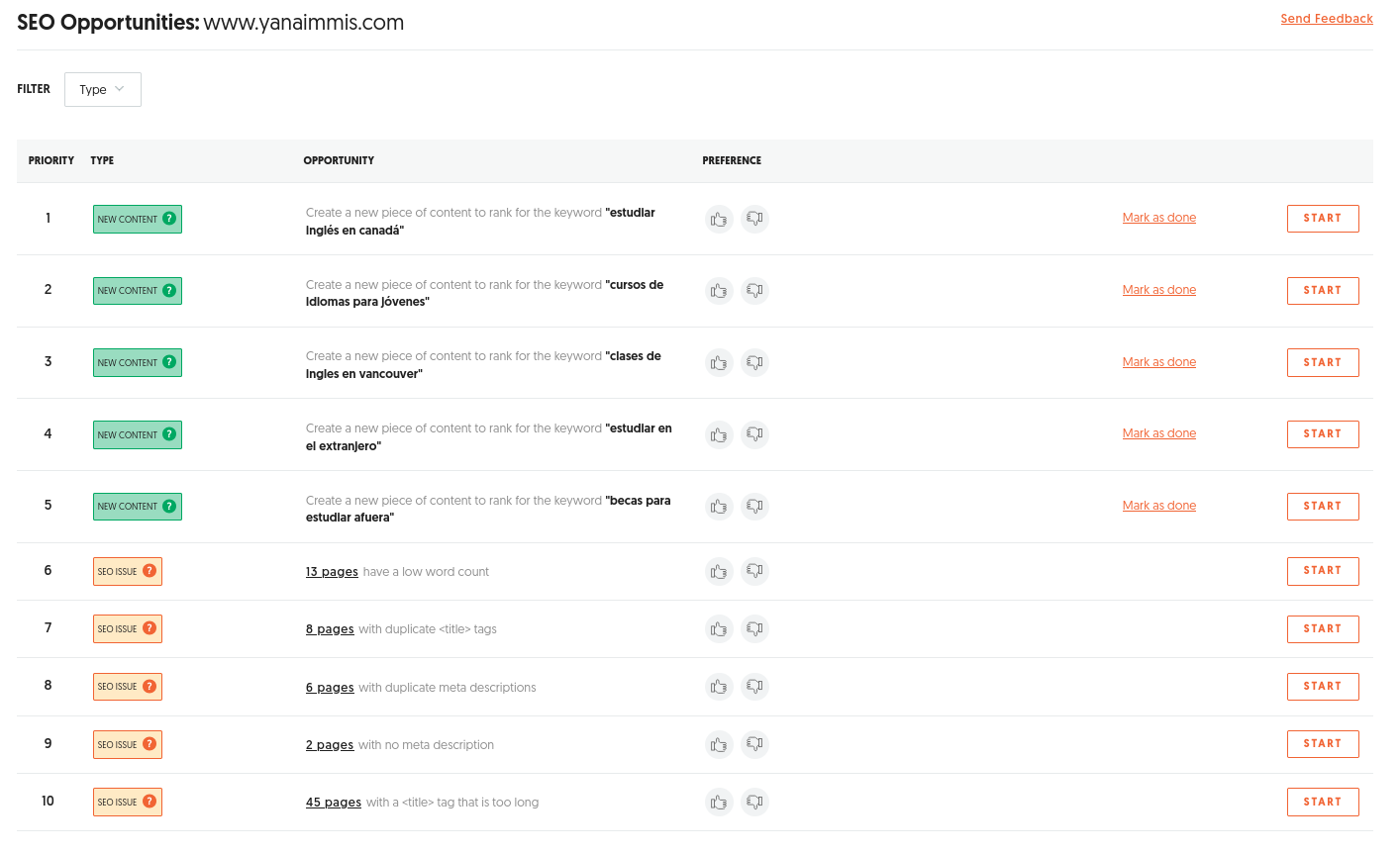
Within Ubersuggest's smaller audit sample, the saved audit flagged 45 long titles, 13 low-word-count pages, 8 pages with duplicate titles, 6 pages with duplicate descriptions, and 2 pages without descriptions. The separate 33-page count above comes from the full 198-URL crawl. These are screening flags, not Google penalties. They identify pages where a search result may be repetitive, unclear, or based on limited page text.
See source detailsSee the checked page groupsOpen full-size screenshot
This inventory covers the homepage plus 18 non-blog core routes from the sitemap. It intentionally does not repeat the 148 article pages, 21 category archives, or 10 tag archives.
Drag the bar above or below the table to view every column.
| Page | Search title | Description & social text | Preferred URL Canonical: the main URL this page asks Google to use. | Share image |
|---|---|---|---|---|
/ | Programs Abroad for Any Age — Yana Immis | Mirrored to OG/X | Homepage / | View image |
/home | Yana Immis Study Abroad Expert — Yana Immis | Mirrored to OG/X | This page |  View image View image |
/about-me | Study Abroad - About Me — Yana Immis | Mirrored to OG/X | This page | View image |
/learn-about-me | Study Abroad - About Me — Yana Immis | Mirrored to OG/X | This page |  View image View image |
/application | Study Abroad - Application Form — Yana Immis | Mirrored to OG/X | This page | View image |
/apply-to-any-university-and-country-here | Study Abroad - Apply to University and Country Here — Yana Immis | Mirrored to OG/X | This page | View image |
/success-stories | Study Abroad - Success Stories — Yana Immis | Mirrored to OG/X | This page | View image |
/contact | Study Abroad - Contact Form — Yana Immis | Mirrored to OG/X | This page |  View image View image |
/faq | Study Abroad (Study In Germany) FAQ — Yana Immis | Mirrored to OG/X | This page | View image |
/schools-and-universities | Study Abroad In Germany - Schools & Universities — Yana Immis | Mirrored to OG/X | This page | View image |
/why-study-in-germany | Study Abroad Why Study In Germany — Yana Immis | Mirrored to OG/X | This page | View image |
/services-and-reviews | Study Abroad - Services & Reviews — Yana Immis | Mirrored to OG/X | This page | View image |
/my-philosophy | Study Abroad - My Philosophy — Yana Immis | Mirrored to OG/X | This page | View image |
/useful-tips | Study Abroad - Useful Tips — Yana Immis | Mirrored to OG/X | This page | View image |
/partner-institutions | Study Abroad - Partner Institutions — Yana Immis | Mirrored to OG/X | This page | View image |
/target-countries | Study Abroad - Choose Your Country! — Yana Immis | Mirrored to OG/X | This page | View image |
/study-abroad | Programs Abroad for Any Age — Yana Immis | Mirrored to OG/X | Homepage / | View image |
/learn-about-germany | Study in Germany: University Programs, Language Programs, Visa Info & Success Stories — Yana Immis | Mirrored to OG/X | This page | View image |
/study-abroad-programs | Expert Study Abroad Agent | Trustworthy Services | Top-Ranked Universities — Yana Immis | Truncated in OG/XFacebook, LinkedIn, and X receive a description that stops mid-word instead of the full text. | This page | View image |
Resources: complete 198-page metadata table, September 3 live metadata inventory, full title and description crawl, live icon observations, sitemap inventory, and browser and structured-data observations.
Related improvement plan: titles and descriptions, sharing and structured data, and preferred URLs.
The page structure exposed to search engines and people using assistive technology.
The site currently has inconsistent heading structure: the homepage contains an empty H3, three H1 headings—“Yana Immis,” “YANA IMMIS,” and “Study Abroad”—and no H2 headings. Across the sitemap, 68 of 198 pages have more than one H1 and 18 have no H1. This is not a Google penalty, but a clearer hierarchy could make each page’s main topic and sections easier for visitors, screen readers, and search engines to understand.
The homepage currently has 166 rendered images, and every image has an alt attribute. That gives the site a usable accessibility foundation. Four descriptions are empty; this is correct for decorative images but would hide meaningful images from screen-reader users. Some linked gallery items also lack clear names, so a screen reader may announce only “link.” These gaps could keep visitors without sight from understanding some of the visual content.
Resources: every crawled page heading and browser structure and accessibility observations.
Related improvement plan: heading structure and linked images and accessibility.
What the public content library covers and the search-demand estimates supplied with the audit.
The site currently has a broad public library: 148 articles, 19 core pages, 21 category pages, and 10 tag pages. It covers country choice, universities, funding, visas, accommodation, student experiences, and recent topics such as visa rejection patterns and study-permit approvals. Without this coverage, the site would have fewer opportunities to answer specific searches.
Success stories, FAQs, institution pages, and destination pages can answer questions people ask before choosing a program or consultant. This existing breadth is useful, but page count alone does not improve rankings. Each page helps only when it clearly answers a real question and gives visitors a useful next step; stronger connections between related pages could make the library easier to navigate and understand.
The supplied Ubersuggest estimates show possible Spanish-language demand for estudiar en el extranjero (480 monthly searches; difficulty 26) and estudiar inglés en Canadá (390; difficulty 28). These estimates can help compare topics, but they do not show that Yana currently ranks or receives inquiries. Matching relevant pages to confirmed search demand could help the site focus its existing content more effectively.
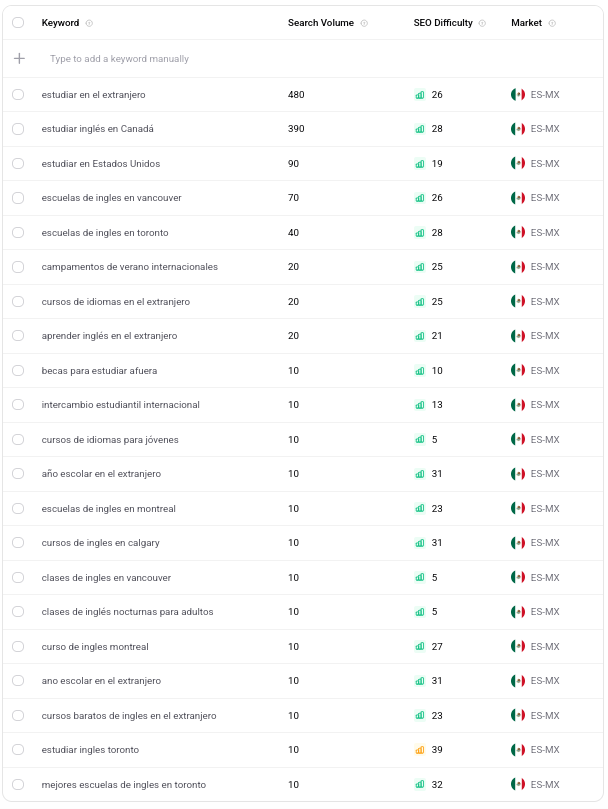
The saved table also lists lower-volume variations for the United States, Vancouver, Toronto, youth courses, and scholarships.
Resources: sitemap inventory, dated article sample, the live blog archive, and Ubersuggest capture.
Related improvement plan: content journeys, regulated advice, article pathways, and demand-led expansion.
Saved real-user and lab measurements for loading speed, page weight, and responsiveness.
The live homepage currently sends substantial HTML and contains many scripts and images. These counts do not determine an SEO score by themselves, but more page resources can increase the work a phone must complete before the page becomes useful. Reducing unnecessary first-view weight could help visitors see and use the page sooner.
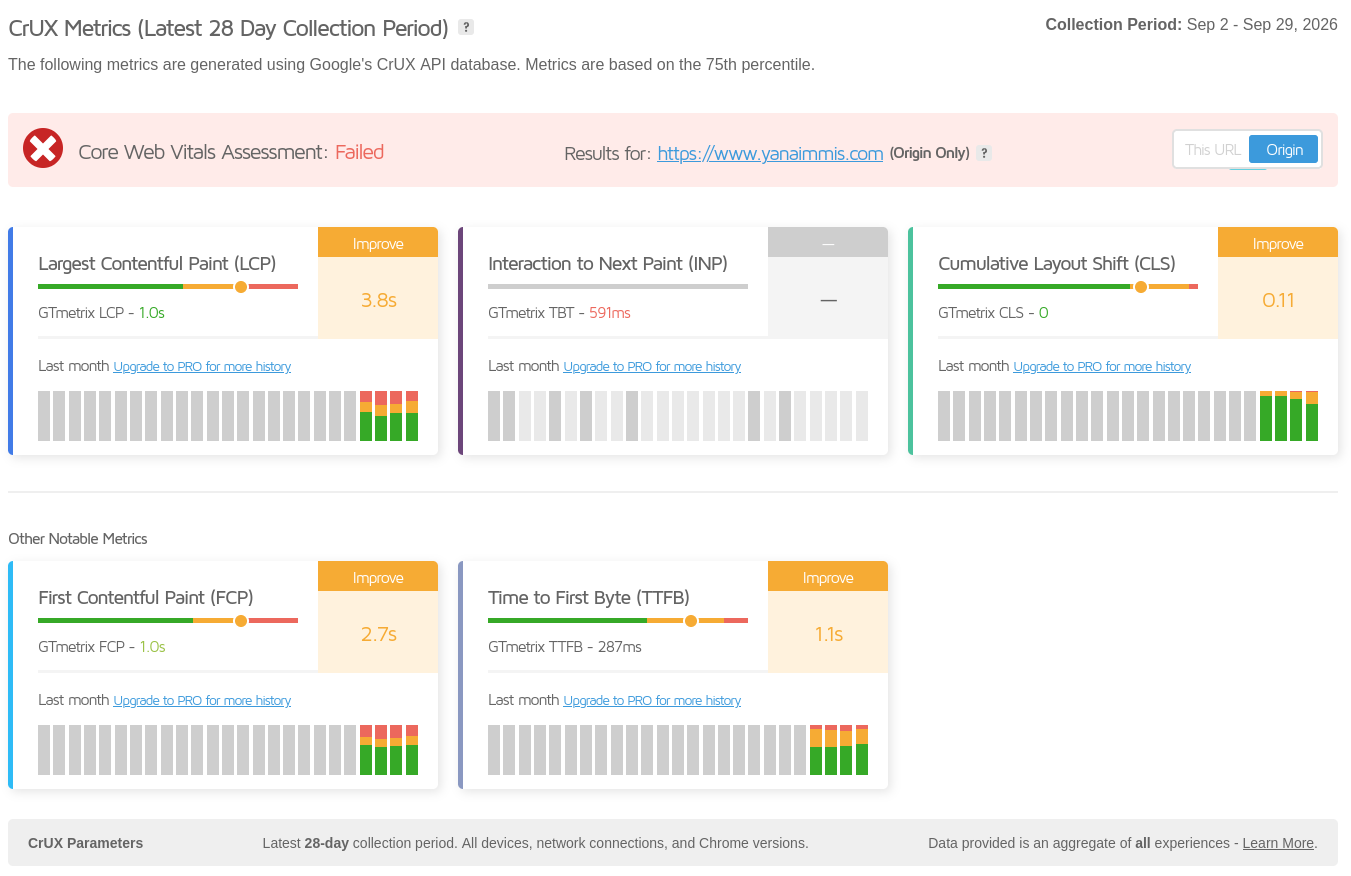
The supplied site-level Chrome data failed the Core Web Vitals assessment. At the 75th percentile, the main content appeared in 3.8 seconds and layout shift was 0.11; both were marked for improvement. First content appeared in 2.7 seconds, the server response was 1.1 seconds, and interaction responsiveness had insufficient data. Faster, more stable loading could reduce the chance that visitors leave before the main content appears.
The capture shows a September 2–29, 2026 collection period that could not be reconciled with the supplied September 3 audit date. It is supplied evidence rather than a verified current-period result. Its real-user method also differs from the PageSpeed lab tests below, so the numbers are not directly comparable.
Six saved reports include separate mobile and desktop Lighthouse results. Every tested page currently has a lower mobile score, and mobile LCP ranges from 14.7 to 15.8 seconds in these lab tests. LCP measures when the main content appears; improving it could help phone visitors reach the service information sooner and strengthen a page-experience signal Google may consider alongside many others.
On smaller screens, scroll the table sideways to view every column.
| Page | Mobile performance | Desktop performance | Mobile LCP | Mobile blocking time |
|---|---|---|---|---|
| Homepage | 53 | 70 | 15.8 s | 210 ms |
| Partner institutions | 55 | 88 | 14.8 s | 180 ms |
| Blog | 49 | 83 | 15.3 s | 330 ms |
| Success stories | 56 | 81 | 14.7 s | 130 ms |
| Learn about me | 50 | 85 | 15.5 s | 320 ms |
| Learn about Germany | 48 | 80 | 15.1 s | 380 ms |
The tested pages currently score 92 on Lighthouse’s SEO checklist and 96 on Best Practices; accessibility ranges from 89 to 95. These scores show that many automated checks pass, but they do not measure rankings, content usefulness, search demand, backlinks, or lead quality. The lower performance results remain relevant because slow pages can affect visitors even when the SEO checklist is high.
Resources: PageSpeed summary, all six Google mobile and desktop report links, and direct document observations.
Related improvement plan: performance testing and scripts, integrations, and first-view media.
Which business-performance data was and was not available for this review.
The review used the live site, sitemap crawl, Ubersuggest, GTmetrix, PageSpeed reports, and browser observations. This is enough to describe the site’s public technical condition, but not its actual search or inquiry results.
The audit did not include access to Google Search Console, Google Analytics, or lead records. Google does not require these tools for ranking, but without them this report cannot identify which searches bring visitors or which pages produce inquiries. Reviewing that data could show which parts of the site already produce results and where improvement would matter most.
Resources: audit scope and data limitations and measurement inputs for a future account review.
Related improvement plan: measurement access and review.